Case study · Security & AI

SecBoard

From scattered security signals to a clearer picture of risk.

A vulnerability management platform that brings 25 security tools into one consistent view, so security teams spend less time assembling the story and more time evaluating what matters.

Evidence-led prioritization. Human judgment stays in control.

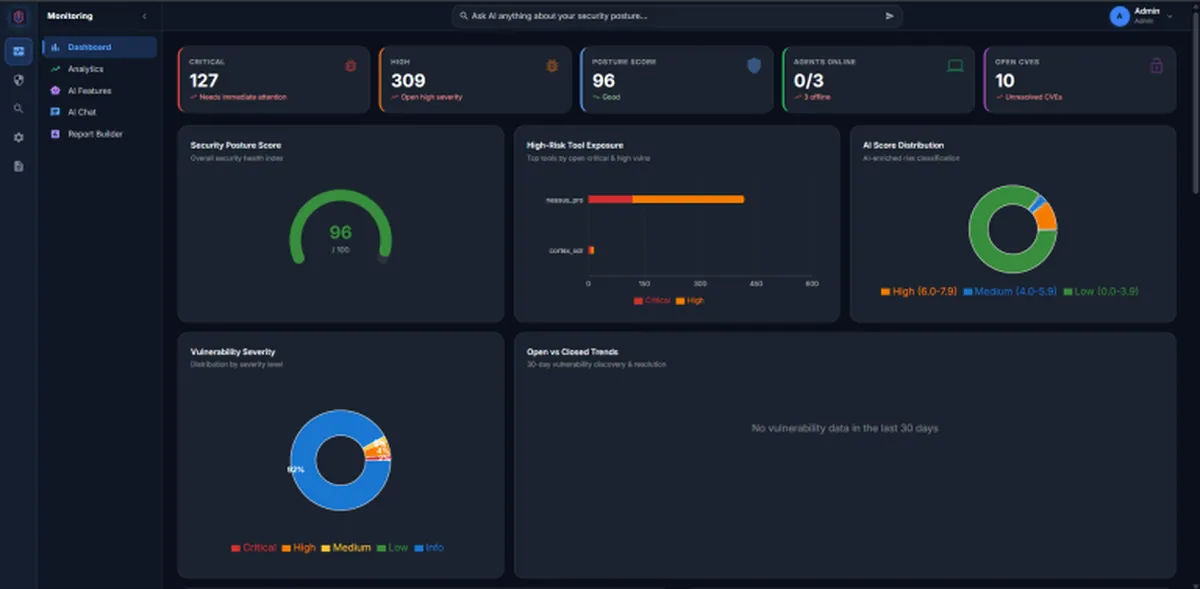
SecBoard vulnerability management platform dashboard showing risk scores and findings from multiple security tools

SecBoard. Product interface from the original portfolio.

25 tools

One consistent source view

Evidence first

Risk assessed in context

Plain language

Questions, not more dashboards

The challenge

The tools were not the problem.

The development problem was normalization. Twenty-five feeds and no shared scale. Every tool described risk differently, leaving teams to open several dashboards and assemble the story by hand.

The goal: preserve each source's evidence, isolate failures and create a consistent basis for risk assessment in one vulnerability management platform — without pretending that a single score tells the whole story.

Built by Maatara Consulting

Engineering case study based on our supplied portfolio. Implementation details and outcomes depend on the deployment environment.

The engineering approach

One view. Better questions.

Keep the original evidence. Make failures local. Bring the important questions into focus. Three principles shaped how the vulnerability management platform was engineered.

Normalize without losing meaning

Each tool has its own agent. The normalization layer translates source data into a shared view while keeping the underlying evidence accessible — and one failing feed cannot take the others down.

Risk is a judgment, not a label

A high score on an isolated test system differs from a moderate score on a business-critical service. Context — reachability, asset criticality and signs of active exploitation — guides what deserves attention next.

Ask a question, not a dashboard

A question about exposure should lead back to the underlying evidence. Plain-language querying supports investigation on the live data, rather than replacing expert review.

A practical stack selected for tool integration, data processing and a consistent product experience across the vulnerability management platform.

  • C#
  • MySQL
  • Go Lang
  • Flutter Desktop
  • REST

A little more clarity

Questions about SecBoard

Good partnerships start with clear answers. Here are a few things you might want to know.

Have another question?

Contact our team

SecBoard is a vulnerability management platform built by Maatara Consulting. It consolidates results from 25 security tools into one consistent view, supports evidence-led risk prioritization and lets users ask questions in plain language, while keeping the original evidence from every source accessible.

No. Your scanners and security tools keep doing what they do well. SecBoard sits above them: each tool feeds its own agent, findings are normalized into one view, and the original evidence stays linked, so teams consolidate the picture without losing the tools.

Severity is a starting point, not the answer. SecBoard weighs a finding's score alongside context such as how reachable the asset is, how critical it is to the business and whether the flaw is being actively exploited. A moderate issue on an exposed, critical service can outrank a high score on an isolated test system.

Only that source is affected. Each tool has its own isolated agent, so an outage, an API change or noisy data from one vendor stays local while the rest of the vulnerability management platform keeps working. The affected agent is fixed without rebuilding the board.

No. Plain-language answers help people investigate faster, but AI-generated answers can be inaccurate. Every answer should be checked against the source evidence it points to, and decisions should stay with qualified security professionals. That is why each answer leads back to the underlying findings.

No. SecBoard helps teams see and prioritize risk more clearly, and it can support evidence gathering, but it does not guarantee breach prevention or certify regulatory compliance. Controls and suitability should be assessed for your own environment, ideally alongside your security and compliance advisers.

Security teams running many tools whose findings do not agree — typically mid-sized and larger organisations with a growing backlog, several scanners and leadership asking for a clear view of risk. It suits teams that want consolidation without giving up the evidence behind each finding.

Yes. We build security platforms, tool integrations and monitoring for complex security estates, and can run security operations as a service. Book a free consultation; an engineer replies within one business day, and an NDA is available before we look at anything.

Need something like this built?

Tell us what you are trying to ship and an engineer will reply within one business day.